%201%20(4).png)
No items found.
Haven
Created for Design for Change 2023, Haven is an application that explores a digital approach to addressing homelessness, one of Canada’s most critical social challenges. The design prioritizes accessibility, clarity, and real-world impact.
Overview:
The application hopes to bridge the divide between those who wish to access support services such as emergency shelters, transitional housing, mental health, addiction and ministerial support. Homeless individuals face numerous barriers when it comes to interacting with government agencies. Issues such as a lack of a fixed mailing address, inadequate transportation and accessibility challenges can all cause a homeless individual not to seek assistance.
Team Members:
Flora Li, Jasmine Dhaliwal, Jaskaran Dhaliwal, Van Linh Khuong, Eric Yam
My role:
Graphic designer, UX/UI designer, Logo designer, Camera Operator
Challenges Of Current Solutions
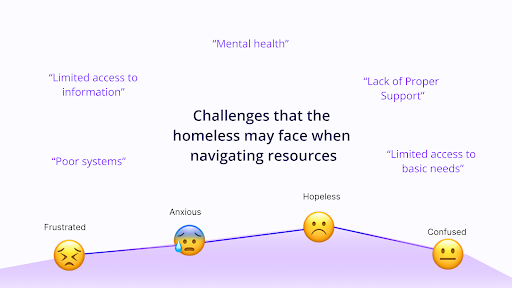
According to the Waterloo Region point-in-time survey, 57% of people first experience homelessness before the age of 45. Among the many services they need, affordable housing and housing search support are considered the most crucial. (CBC, 2021) So when we were asked, “How might we turn care and compassion into tangible solutions for people experiencing homelessness?“ we decided to focus on navigating the challenges of transitional homelessness to streamline their first experiences in this difficult process. So what are the challenges of current solutions? Our secondary research has uncovered some common barriers that leave many feeling frustrated. From limited accessibility to scattered information to long processes - the challenges of navigating resources can be overwhelming.
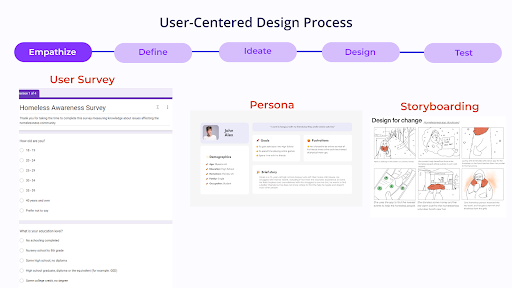
Our Design Process
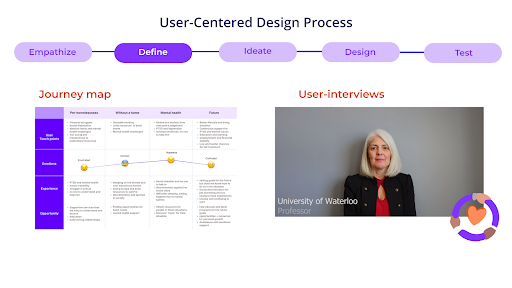
Our research focused heavily on a user-centric design approach, feel free to pause if you want to check out any of the takeaways we gained from each step. We want to highlight that we conducted user testing to ensure that the solution would meet accessibility needs.
Interview Video
We then interviewed 8 indirect stakeholders on their thoughts on homelessness, and here’s what they had to say:
Persona
Introducing Haven, the app that helps link individuals to resources and supportive networks, no matter where they are. With its interactive map to locate available resources, personalized saved options, and an AI-powered chatbot for direct connections to resources, Haven is the ultimate solution to streamlining the transitional process.
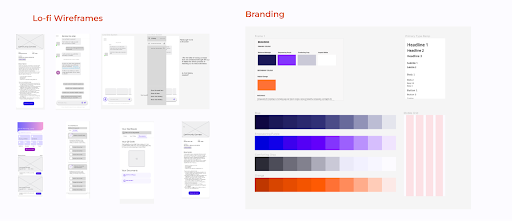
Design System

Onboarding and Map
Once the user completes the onboarding process, they can navigate to nearby locations with the interactive map that is intuitively categorized. To help ease the frustrations of long processes, this feature was designed to allow users to easily filter and find available help. As you can see, this feature is designed with simplicity and convenience in mind. When navigating, user can select their location and choose their mode of transportation. We have also included an AR view for low-light environments and a save button for quick access to saved resources.
In order to address the challenges with scattered information, users can view their saved resources like shelters and events based on upcoming and registered. We used feedback from user testing to ensure that the user is able to view the information in a way that is easy to digest and fill in any registration forms within the app.
This ties in with the settings tab where users can use their QR code to easily connect with services like shelters. The users are also able to select their data personalization settings to ensure that their privacy is a priority.
We know that every user’s journey is unique, which is why we developed an AI-powered chatbot that offers personalized support. Our chatbot directly connects users with resources in-app, ensuring that they receive the care and attention they need. With 24/7 availability and real-time responses, users can receive immediate assistance and avoid waiting for support.
By providing access to resources and support, we aim to empower individuals and make a real impact in their lives. Together, we can build a future where everyone has a place to call home - their Haven.