%201%20(4).png)
No items found.
Monthly Muse
The Monthly Muse project is an innovative solution to transform the fashion industry towards sustainability. The app’s user-friendly empowers customers to rent and experiment with new clothing items every month, significantly reducing their carbon footprint.
Monthly Muse is a dedicated effort to combat the negative impacts of fast fashion and promote sustainability. Extensive secondary research has illuminated a concerning trend: one in three young women perceives clothing worn only once or twice as outdated. This alarming insight led us to focus on women aged 20 and above who aspire to enjoy fashion without breaking the bank, all while prioritizing sustainable choices.
Team Members: Jasmine Dhaliwal, Flora Li, Linh Khuong, Connie Kang, Jaiee Satpute, Megan Duong, Tyler Tewari.
My Role: Graphic Designer, UX Designer, UX researcher, and Actress in our product advertisement.
Overview:
Fast fashion is more than just trendy clothes and low prices. It involves everything from labor practices to consumer behavior, and it impacts the environment as well. And we think that understanding the scope of this issue is crucial in creating a sustainable and ethical future for the fashion industry.
This industry alone accounts for 10% of global greenhouse gases and nearly 85% of the clothing consumed leads to almost 80 pounds of waste per person annually. By supporting sustainable fashion brands and making conscious clothing choices, we can help reduce waste, improve working conditions, and contribute to a better future.Our secondary research revealed that one in three young women consider clothes worn once or twice to be outdated. Our survey results also indicated that 75% of the people who were interested in using our application were women aged 18-34.
Hence, after conducting surveys and secondary research, we decided to target women aged 25 and above who aspire to purchase luxury clothing but are unable to afford it, while also prioritizing sustainable fashion choices.

Design System:
Designing modular & scalable solutions
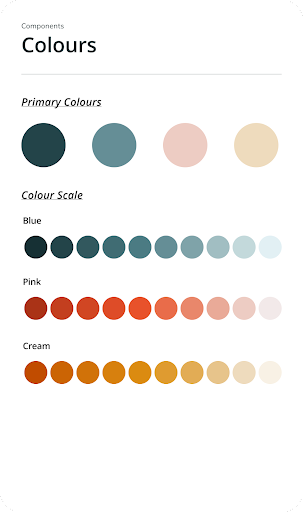
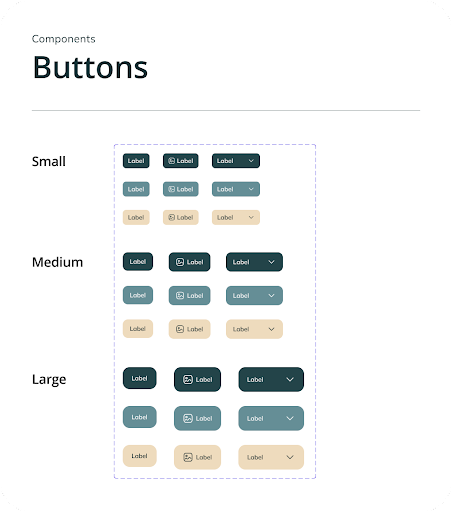
An extensive design system was built to support scalable design in our solution. An emphasis was put on designing components that could accommodate lists of items of 0 to infinite.


Prototype:
The development of the Monthly Muse application involved creating a product that balances functionality and user-friendliness with environmental sustainability. Our design process began with a thorough understanding of the problem and user needs.
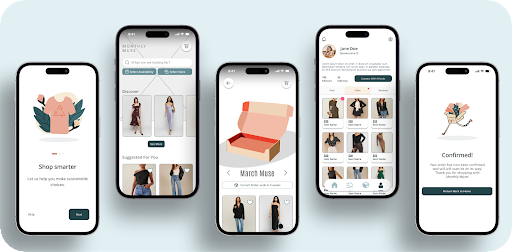
Personalization is an important feature Monthly Muse aims to provide. During the onboarding process, users will be prompted with clear instructions to provide specific information that will help create a more tailored app that will fit their needs.

After completing the onboarding process, users are guided to our homepage which has a range of features including Search, Size, Availability sorting, Discover, Suggested For You, and more. Upon clicking an item, users are taken to its dedicated page, complete with a Virtual Try-On feature to enable them to preview the clothing on their own body. Users can customize their selection by choosing the color, size, and method of purchase.
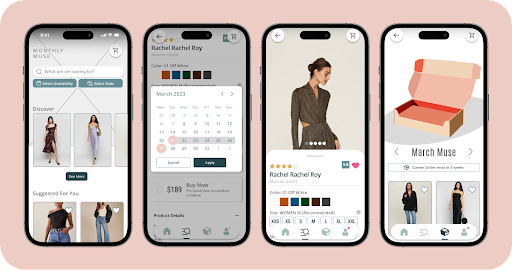
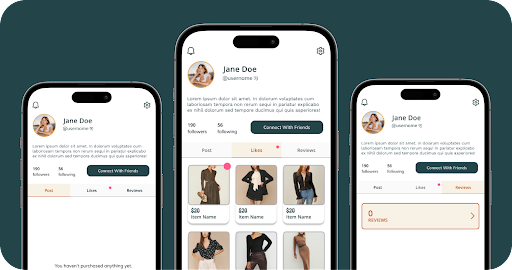
The profile feature is crucial as it allows users to connect with others, personalize their experiences, and provide valuable feedback. The first key aspect is the option to share items purchased by connecting with social media accounts. This will help the app reach a broader audience as users’ followers can discover the app through their posts. Next, users can leave reviews of the clothing items they have purchased, providing valuable feedback to other users who are considering purchasing those items. Finally, users can save their favorite sustainable clothing items to their profile, making it easier to find and purchase items. Other key aspects include the settings and notifications which are placed at the top for easy access when needed. Users are also able to connect with close friends by clicking the “Connect With Friends” button.
To complete a purchase, users must go through the checkout. As this process can be quite overwhelming as the user has to fill out multiple boxes of information, the key to any good checkout flow is simplicity and straightforwardness. With clearly labeled headings, buttons, and instructions, users are easily guided through the process. To make the process even more understandable, a progress bar is shown at the top of each screen to indicate which step the user is at in the checkout process.
